

Last week, I began offering my post-SBC 2026 analysis. As I reflected on the real and encouraging wins that the SBC Reformers secured in Orlando, I asked, “What will it take to turn these initial victories into lasting change?” Or, in other words, “How can the outside-the-system grassroots Reformers matriculate into inside-the-system institutional leaders?”
In answer, I proposed four lessons that the SBC Reformers need to learn: 1) Gain more institutional support; 2) Build better coalitions; 3) Master SBC politics; and 4) Make more emotional appeals.
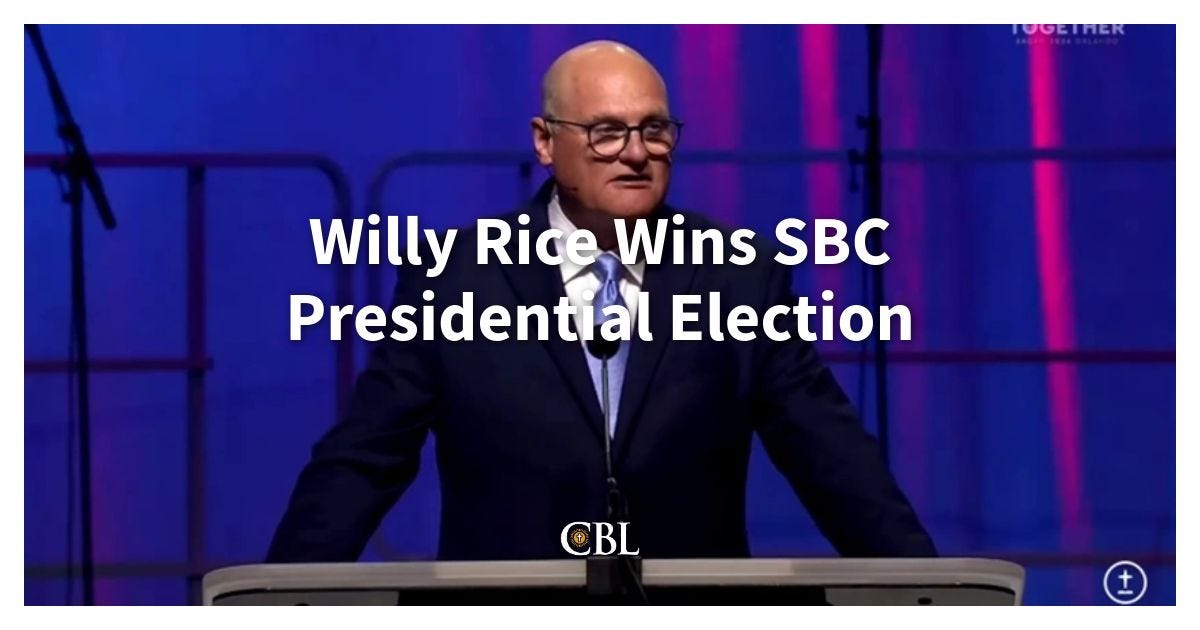
In Part One, which you can read here, I covered the first two lessons on the need for more institutional support (which, Lord willing, we will be receiving from both Willy Rice and Albert Mohler) and building better coalitions (which will involve humility and courage across the different camps in the SBC Conservative Reformers family).
This two-part entry is, in many ways, a continuation of my post-Dallas 2025 and pre-Orlando 2026 analyses and uses terminology that I explain and define in those articles. You can find the first one here, “The Status Quo Convention: Six Takeaways from Dallas,” in which I first used the taxonomy of “Platform, Loyalists, Reformers, and Normies” to break down the four major groups in the SBC. And you can read my pre-Orlando commentary here, “SBC Orlando Isn’t Dallas. It’s Nashville 2.0,” in which I predicted that changes championed by the Reformers were finally coming this year.
By God’s grace, they did. But the work is far from over. The Truth & Unity Amendment still has to be ratified in Indianapolis. We need to elect Willy Rice for a second year, and then someone in his same vein for the next two years after that, and beyond. We need to get Reformers placed on critical committees in the SBC, including Convention operations and trustee boards, among other roles. We still have other major issues that need to be debated and won, particularly on increased financial transparency and entity accountability.
SBC Reformers need to learn to assume the center and strive to govern. So, in Part Two, I now turn my attention to why Reformers need to get better at SBC politics on the ground at the Convention and learn to make more appeals to the hearts of those “in the room.”
#3: Reformers Need to Master SBC Politics
Conservatives have better arguments. Our positions are more doctrinally sound, more logically coherent, and more biblically grounded. And for a long time, we have assumed that would be enough.
Some of us assume this is all we need to win the day. But it doesn’t work that way.
My next two points concern how the SBC actually works.
Reformers assume people will be persuaded by biblical arguments and rational logic. I’ve learned the hard way that this isn’t always the case. In SBC life, we assume we simply need to persuade people that a given amendment is biblical and correct, and people will vote accordingly. Again, not true.
Oftentimes, people aren’t persuaded of a position and then vote for it. Rather, they are persuaded by a position because it’s the one everyone voted for. That’s a subtle but important difference. People are complicated. We’re not always rational. That’s why it’s important that we master the art of politics, because that’s how decisions are made at this kind of scale. And the decisions made at the convention end up having a persuasive power of their own.
Put simply, denominational politics isn’t a distraction from the real work of ministry. It is a load-bearing aspect of real ministry.
We don’t need to tell the “left wing” of the Convention this because they already know it. It’s why they’re so good at it. It’s the Reformers who need to learn it.
Many of us are too averse to politics because it feels dirty. Strategizing about votes, campaigning for issues, and planning a convention ground game don’t feel very spiritual, and we’re in this because of our spiritual convictions. So we do what’s comfortable: making arguments, articulating positions, and exegeting scripture, while our opponents have mastered Robert’s Rules, chair committees, and run rings around us politically. We avoid getting in the weeds of convention floor procedure, lining up support months in advance, and thinking about who nominates whom and what they will say, because none of that feels like trusting God.
But those who oppose us figured out years ago that those things are essential for victory. The left wing of the convention has a nose for power. Even though their arguments are paper-thin, they win anyway because they know how to play the game. That is why they have had disproportionate influence.
But things felt different this year, and I can give you two examples.
First–and I have no insider knowledge of what I’m about to say–Willy Rice appeared to have a brilliant campaign strategy. I don’t know if it was intentional or not, but if it was, this was a model of what good politics looks like on our side. The convention was in Florida, so it’s plausible that he picked this year to make his run, being on his home turf. He also happened to have a preaching slot at the pastor’s conference, where he delivered a fantastic message on the need for reform in light of the scriptures.
In the run-up to the Convention, I’ve heard he met with many associational leaders, state leaders, and ordinary pastors. He listened to them and heard their concerns. He made a personal connection with people who were within a reasonable driving distance of Orlando. He showed up to forums and answered questions, even from hostile audiences. In other words, he spent months campaigning across Florida and beyond, articulating his vision for reform, explaining what he wanted to do and why, and running it like a real political campaign. By the time messengers arrived in Orlando, there was already a base of supporters who knew their vote and were telling others.
In the weeks prior to the Convention, I heard him say he hadn’t yet decided who he would ask to nominate him. That was a smart move to keep everyone guessing. When the time for nominations arrived, pastor Adrian Taylor of Springhill Church in Gainesville, FL, gave a powerful speech, striking precisely the right tone. That was no accident. Willy picked the right man for that moment. I wouldn’t be surprised if many fence-sitters made up their mind right then and there. To me, Rice seemed like a man who knew what he was doing and was on a righteous mission to see it through. He ended up being, as Baptist News Global’s headline indicated, the first reform candidate to win the SBC presidency in 35 years.
A second example is the “good politics” that took place on the Convention floor. I arrived at the Convention early Wednesday morning, hoping to secure one of the eleven microphone spots so I could speak in favor of the Truth & Unity amendment. When I arrived, however, just after the doors opened and the cavernous room was still mostly empty, I realized that every microphone was already taken, two messengers deep at each. My heart sank, thinking opponents of the amendment showed up to control the mics, condemn the amendment, and doom the effort. I went to the mics anyway and struck up a conversation with the messengers. I found out they were there to speak in favor of the T&U amendment, and they had friendlies at all the mics. I was thrilled.
The messenger in front of me was holding what appeared to be a dossier with a cover sheet that said “SBC 2026.” I watched him open it up and read over his speech. I assume all the messengers at all the microphones, which would be at least 22 of them, had similar notes. That’s a solid ground game. I was third in line. A man came up behind me to speak against it, making him fourth in line. He was hostile to the amendment. Neither of us had a chance to speak.
When the time came for people to speak from the floor, Mohler spoke in favor; another messenger spoke against; then Colin Smothers gave a wonderful speech in favor and called the question. I’ve since seen people complain about shutting down debate, but Smothers merely utilized the system we’re in. It was smart politics, and we won the vote. More of this, please. This is what we need to replicate and build on.
#4: Reformers Need to Make More Emotional Appeals
Finally, Reformers need to realize that emotions win votes. Arguments inform people, but emotions move them. We can lament the fact, but it remains a fact.
I can give you two examples of this from Orlando.
First, during the debate over holding a future convention in Anaheim, one messenger made a case against meeting in Anaheim, CA, arguing that it would give liberals an advantage and that we shouldn’t hand it to them. He is factually correct, but he lost the room at that moment. That kind of argument plays well amongst the Reformers, but it didn’t translate well on the Convention floor. Why? Because at the Convention, people respond to emotions, and positivity is the preferred vibe in the SBC. I think people probably thought it sounded combative because it was framed in a somewhat divisive way. The messenger wasn’t wrong in his argument, but an emotional appeal would have been more persuasive.
At that moment, I think a more persuasive argument would have been to point out the significant drop in attendance the last time we met in Anaheim. We had 15,726 messengers in Nashville in 2021, but that dropped to 8,133 the following year in Anaheim–we dropped by almost half! A negative message is “don’t let them have the advantage!” A positive message is “let’s make sure our people can show up.” I don’t know if that would have persuaded the room, but a positive framing could have made a difference.
A second example came from Benjamin Cole. I don’t know him personally, but he clearly knows how to use emotional appeals at just the right time. Toward the end of the morning session, as the room grew tired and ready for lunch, he walked to the microphone and argued that the Executive Committee was overburdened with too many task forces. He said they had too many assignments and too little capacity to do them well. He invoked Exodus, in which Pharaoh forced the Israelites to make more bricks with less straw. He delivered it powerfully. It was a compelling, biblical image, and he won over the room in three minutes.
He moved to dismiss the task forces, then immediately called the question. His motion passed easily, erasing all the work we’d just completed that morning.
I sat there, stunned. It happened so fast that half the room didn’t fully understand what had just happened. That is the power of a well-timed, emotional argument delivered to an exhausted room. Benjamin Cole knew what he was doing.
What This Means for Indianapolis
So, what now? Between now and Indianapolis, opponents of the Truth & Unity Amendment will make their case. Some of it will be deliberately misleading. Some will dust off Rick Warren’s old fear-mongering playbook that reformers are trying to prevent women from sharing the gospel at all. It’s nonsense, but fear is an emotion that moves people. Many uncertain messengers will feel its pull.
What can we do? Of course, between now and then, we need to make our biblical case relentlessly. We need to use scripture, logic, and sound reasoning. However, as discussed above, when the Convention rolls around, we also need to be politically savvy and speak in an emotional register that moves people. We need stories, not just syllogisms. This is not abstract denominational polity, but an issue that affects real churches and real congregations. And real damage is done when our confessional clarity erodes.
And we also need to identify our allies and build coalitions. The wins in Orlando were real. The Truth & Unity Amendment passed, and Willy Rice is president. We can praise the Lord for these answered prayers. Now, we’ve got one year until Indianapolis, where we can make some of these gains permanent.
The question now is this: Will we use this next year to consolidate, organize, build the coalitions, develop the ground game, and show up in Indianapolis ready to govern?
Or will we go home, declare victory, and repeat the same mistakes that have cost us for a generation?
Loser Theology Preorders are now LIVE!


My new book, Loser Theology: Why the Weak Will Not Inherit the Earth, is now available for preorder from Canon Press. It will ship August 4th. In the image above, you can see a screenshot of the first three endorsements from C. R. Wiley, Katie Faust, and Jon Harris.
Willy Rice, the new president of the Southern Baptist Convention, said:
“This book is fantastic. Michael Clary’s book is like a trumpet blast to rouse a sleeping giant. Written from the trenches of real pastoral ministry, it offers a spellbinding diagnosis of what went wrong and a prophetic yet pastoral call for correction. The way of the cross is not capitulating to culture as a victim, but confronting principalities and powers with confidence in the power of God and a willingness to pay the cost of victory.”
Canon Press has made the book’s opening chapter available for FREE at www.losertheology.com.
For what it’s worth, pre-orders will ship faster from Canon Press. Canon’s preorders will ship on August 4th. Amazon’s preorders ship August 18th.