

The pre-orders for my new book on Loser Theology went live yesterday at Canon Press. The hardcover ships from Canon Press on August 4th (it’s also listed on Amazon, but Amazon pre-orders won’t ship until Aug 18th).
I received an overwhelmingly positive response to my preorder announcement on X.

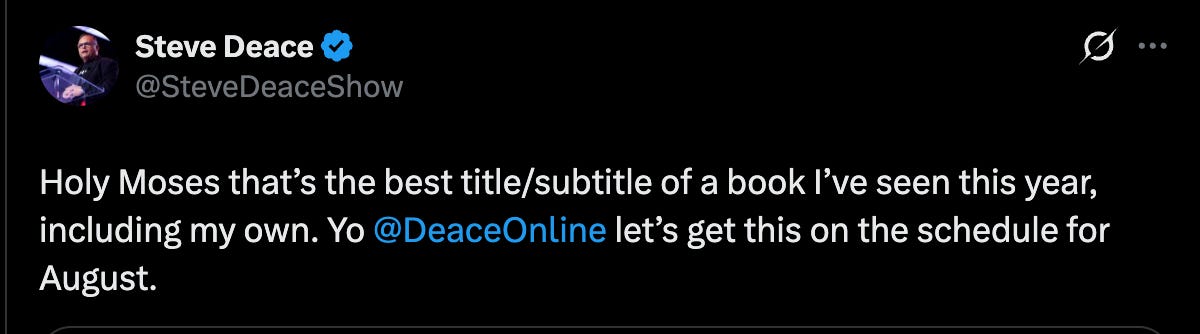
Steve Deace reposted it and said, “Holy Moses that’s the best title/subtitle of a book I’ve seen this year, including my own.”
My friend Michael Foster also reposted it and wrote a warm endorsement, saying,
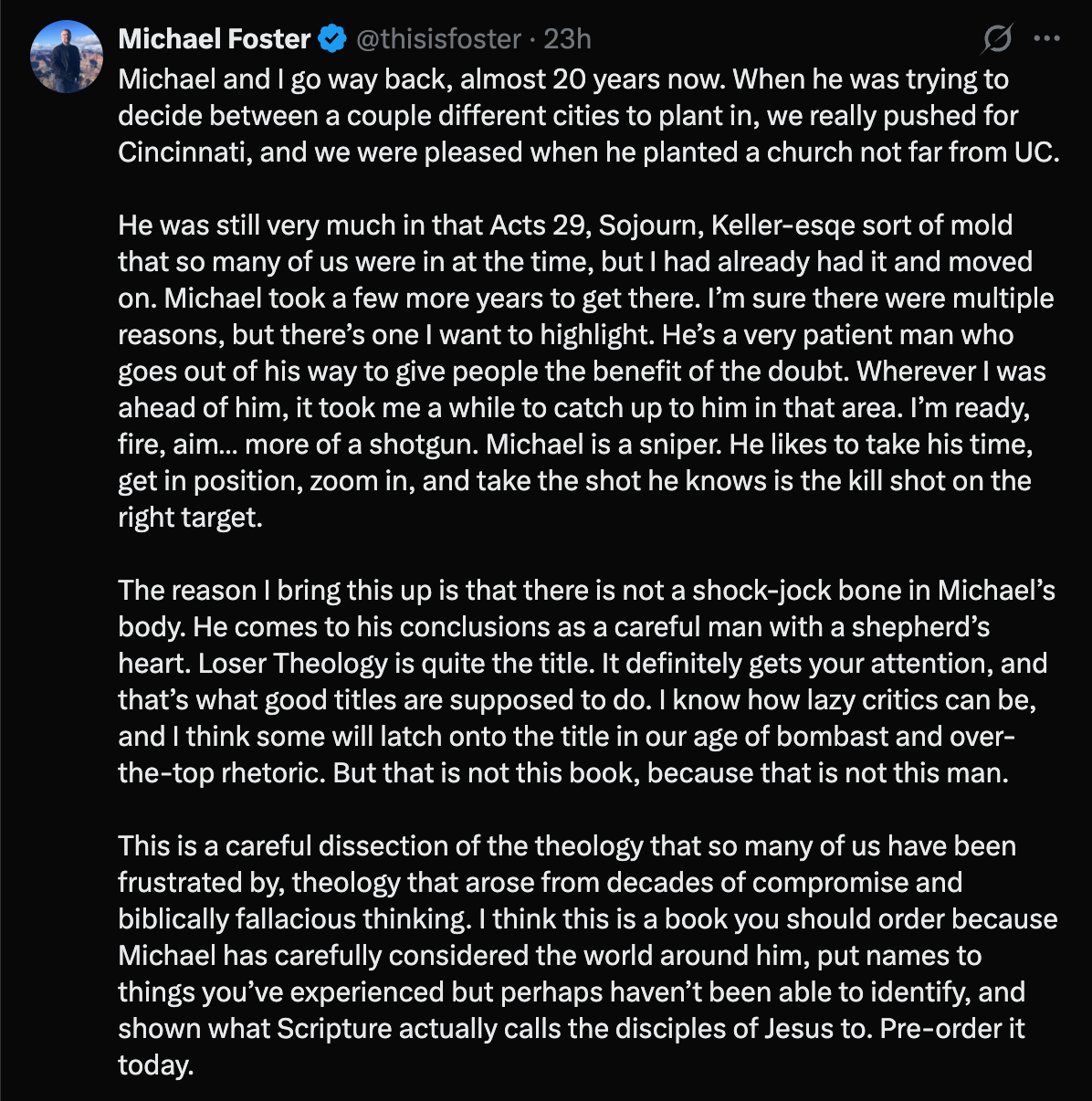
Michael and I go way back, almost 20 years now… There is not a shock-jock bone in Michael’s body. He comes to his conclusions as a careful man with a shepherd’s heart. Loser Theology is quite the title. It definitely gets your attention, and that’s what good titles are supposed to do. I know how lazy critics can be, and I think some will latch onto the title in our age of bombast and over-the-top rhetoric. But that is not this book, because that is not this man.
This is a careful dissection of the theology that so many of us have been frustrated by, theology that arose from decades of compromise and biblically fallacious thinking. I think this is a book you should order because Michael has carefully considered the world around him, put names to things you’ve experienced but perhaps haven’t been able to identify, and shown what Scripture actually calls the disciples of Jesus to. Pre-order it today.
One Commenter on X Just Proved My Whole Thesis
Predictably, a few commenters jumped in with pietistic responses. A guy named Luke took exception with the title, saying, “Loser theology is the ultimate and correct theology and the direct and truest Gospel of our Lord. We are called to be weak.”

I suspect many people will agree with Luke’s take, which will be the most common objection to my argument. The problem with Loser Theology isn’t that it affirms things that are blatantly false, the problem is that it over-focuses on the Bible’s teaching about suffering and weakness, regarding it as the “correct theology” and the “truest Gospel of our Lord” and “we are called to be weak.”
If Luke is correct, then I wonder how he applies it? Are Christians called to be always weak, all the time, and in every way? Is he in sin if he works out at the gym? If someone is threatening his wife, will he step in to defend her? Or will he simply tell her, “sweetheart, there’s nothing I can do. Jesus calls me to be weak”? When he goes to the voting booth, does he hope his preferred candidate will win?
Luke’s comment is “exhibit A” of loser theology, which has conditioned Christians to feel guilty for standing up for ourselves and asserting the Lordship of Christ over all of life. If Luke chooses to live this way, that’s a discipleship issue. But when loser theology is adopted at a large scale, evangelical Christians face a massive existential crisis.
Bible believing Christians end up somehow thinking it is our spiritual duty to be subject to tyrants. We end up believing the more faithful path is being doormats for Jesus. We end up allowing pagans to step on us—and then we go to heaven. We’re watching this play out before our eyes as our society continues its moral decline while Christians sit on the sidelines, praying our prayers of lament, but doing nothing to oppose it.
In my book, I make the case for why Luke’s way of thinking can sound good and holy but be ultimately wrong. In fact, I wrote recently about 2 Corinthians 12, where Jesus says, “My grace is sufficient for you, for my power is made perfect in weakness.” But “weakness” isn’t the only word in Paul’s vocabulary. Also, “weakness” doesn’t mean what Luke thinks it means, since scripture also commands us to “stand firm in the faith, act like men, be strong” (1 Cor 16:13). In fact, the scriptures have a lot to say about Christian strength.
So, if you are interested in understanding why Christians aren’t called to be losers, and if you’d like to understand how Christians can wield power righteously for the glory of God, then “Loser Theology” is the book for you. Canon Press has actually put the first chapter of the book on the pre-order site to read for free, so you can get a feel for the argument and what the book is about.
Why Pre-Order the Book Now?
You might be thinking, “I’ll order the book once it comes out.” That makes sense, but there’s a reason why publishers do pre-orders, and you can help me out if you’d be willing to pre-order it. Let me explain.
We’ve got about a six week pre-order window. All those pre-orders will count towards the first week’s book sales, and a strong first week is critical for reaching the broadest audience. Basically, when all pre-order sales get counted during the first week of a book’s release, it gives it a bigger splash in the market, generating buzz, and helps the book land on “popular new release” lists, which generate further sales.
I want this book to perform well in the market because I’m convinced this is an urgently needed message that merits serious consideration. I’m praying that this book will provoke a broad conversation in the evangelical world about what it means for Christians to faithfully represent Christ from a position of courage, clarity, strength, and even (righteous) power. This isn’t a book primarily about politics, but if the book’s warnings and exhortations are heeded, it will have a political effect.
All that to say, pre-orders lead to a strong opening week, and a strong opening week will push the book’s argument deeper into the evangelical conversation. That’s what I’m praying for.
So, if you’re willing, pre-order Loser Theology today!
So glad you made this a book! Fantastic!
I look forward to reading this book.