My latest piece at the Center for Baptist Leadership is now up. It’s a reflection on the 2026 convention in Orlando along with lessons for victory next year.
It’s time for the Reformers to assume the middle and strive to govern. To do so, we need to learn four lessons.
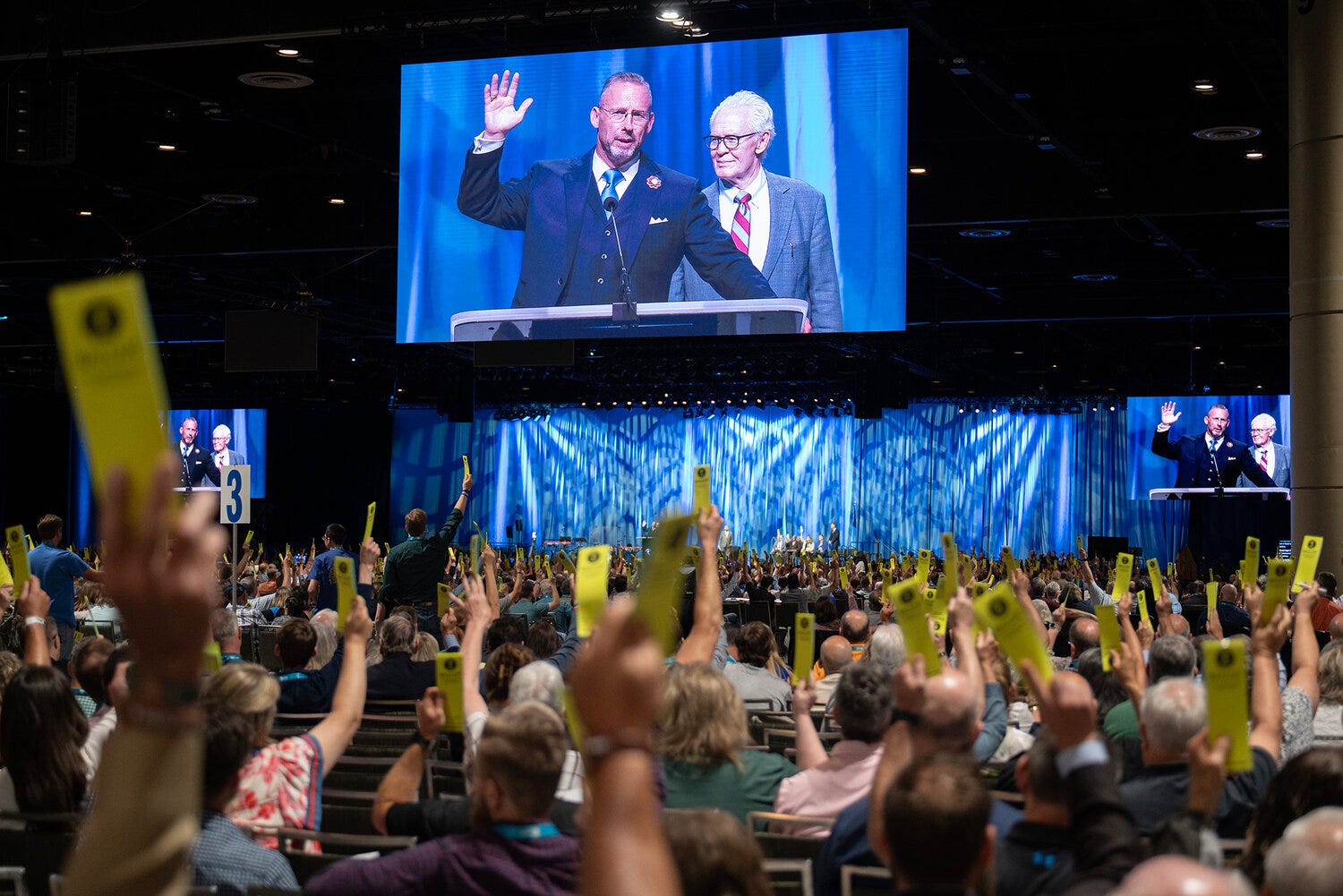
Two weeks ago, many conservative Southern Baptists went home from Orlando happy. Willy Rice won the presidency with a clear majority. The Truth & Unity Amendment cleared its first hurdle as it heads towards (Lord willing) final passage next year in Indianapolis.
The “Reformers” in the SBC (one of the four groups I outlined in my recap from the 2025 Dallas annual meeting) had something to celebrate, and we should readily acknowledge it.
To briefly reiterate, “Reformer” here is not about “reformed” theology. As I explain, the Reformers in the SBC are “the ones who see the SBC slowly but surely heading over a cliff and are advocating for needed fixes and reforms to our theology, public witness, and internal Convention operations that we believe would revitalize the Convention, defend our Baptist distinctives, and most importantly, honor the Lord.”
But there is an undeniable reality looming on the horizon: the electoral victories in Orlando must translate into institutional victories if we are to see sustained reform and renewal in the SBC. And that requires a different kind of work than most of us Reformers are used to doing.
So over the next year, between now and Indianapolis 2027, I think there are four lessons that the Reformers need to learn and apply to translate our initial victories in Orlando into long-term changes. I’ll discuss the first two (gaining more institutional support and building better coalitions) here in Part One and the second two (mastering SBC politics and making more emotional appeals) in Part Two, which will be published tomorrow.
Let’s get started.
#1: Reformers Need More Institutional Support
Reformers regularly speak out about institutional corruption, and for good reason. Sometimes the institutions really are the problem. But that doesn’t mean the institutions are always the problem. Institutions were originally built to be our most powerful allies, not our enemies.
Take the Law Amendment, for example. Mike Law drove that effort with remarkable tenacity, and he moved the ball down the field on grassroots energy alone. But ultimately, it failed on its second required vote. Why? A significant reason is that he lacked institutional support.
But beyond a lack of support, the Law Amendment also faced massive institutional opposition in its second year. Not only were there not enough vocal, public, institutional supporters among prominent SBC figureheads between the first vote on the Law Amendment in New Orleans in 2023 and the second vote in Indianapolis in 2024, but many SBC leaders (like former SBC president Bart Barber, NAMB president Kevin Ezell, former SBC president JD Greear, etc.) actively worked to undermine and kill the Law Amendment.
Grassroots efforts can make a lot of noise and build a lot of momentum, but when the institutions are actively working against us, grassroots energy alone is rarely enough to carry it across the finish line.
By contrast, the Truth & Unity Amendment seeks to accomplish essentially the same goal as the Law Amendment, but now it has Al Mohler as an institutional champion. He picked up the baton and brought real institutional weight to the table this time. His presidency of SBTS also has coattails. Mohler’s credentialed voice carries more authority at the Convention than that of an ordinary pastor like Mike Law. We may not like it (and, in fact, it’s a real issue, as Sam Webb explains well here), but it’s a fact.
Mohler didn’t just say, “I support this”; he put his name and legacy on the line to see it through. That seems to have made a difference in Orlando, and time will tell if it’s enough to ratify it next year in Indy.
Furthermore, Reformers now have another major institutional champion for the Truth & Unity Amendment in our new SBC president, Willy Rice. In his first post-Annual Meeting press conference, Rice said, “I’ll do everything I can” to help get Mohler’s Truth & Unity Amendment ratified in Indianapolis.
There’s a broader lesson for the Reformers. There’s a certain energy and thrill that come with being in the minority, fighting an uphill battle against a perceived Goliath. We can even become psychologically addicted to being in perpetual opposition mode to the extent that we don’t know what to do with ourselves when we win. Like the dog chasing the car, we get confused when we catch it.
It’s not enough to complain about institutions; we have to work with and within them to make a lasting difference.
Simply put, electoral wins are not self-sustaining. Reformers need to get onto committees, pursue appointments, and begin occupying positions of power inside the system, even knowing we will be minorities on those committees, at least for now. Reformers will need to sit in committee meetings alongside trustees and committee members appointed by J. D. Greear, Bart Barber, and Ed Litton. Reformers need to work alongside men who do not share our convictions until they cycle off, and more reformers can replace them.
Genuine reform takes years of boring, tedious, institutional work, being outnumbered by people who do not share our convictions and goals. We’ve got to be fine with that, and we’ve got to allow time for the influence of Willy Rice’s appointments to take effect. The point is to be in the room, pick smart battles, play the long game, and build toward a day when reform-minded men hold those seats in numbers that really matter.
Regarding the problem of women pastors in the SBC, the credentials committee is where the real action happens. We need more reformers on that committee. They may be outnumbered at first, but they should be there anyway. And that leads me to my next point.
#2: Reformers Need to Build Better Coalitions
“Reform” energy is pure and convictional, and it’s not natural for us to shift into a leadership mode that requires us to establish consensus and build coalitions. We need to fix that.
We must be shrewd, humble, and patient as we hunker down for reform efforts that will likely take a decade to accomplish. Simply put, reformers will need to use different muscles to make our reform efforts permanent within institutions, and that will require more consensus and coalition-building than we’re accustomed to.
From my observation, there are a few formal and informal power centers in the SBC. All of them operate under the same SBC tent, and there’s a great deal of overlap between them. But if you pay attention, you can see where existing coalitions are, understand what motivates each, and determine where new alliances and coalitions can be formed to further our reform efforts.
I like to think of these as mob families. That’s a playful label, not a jab. It’s just a fun way to categorize groups and understand where they are alike or different from one another.
Here are the five families I’ve observed, which break down into three coalitions.
The Status Quo Coalition
The largest and most institutionally entrenched family is the NAMB/SEND Network family, led by Kevin Ezell. In many respects, NAMB/SEND functions more as an independent power center than a true tribe. NAMB is the second-largest SBC entity behind the IMB, but unlike the IMB, it focuses exclusively on the American home front. NAMB is very pragmatic, moderate, and numbers-and growth-oriented. They are not interested in helping “fight for the doctrinal fidelity” of the SBC or supporting any kind of reform and renewal initiatives. It’s no secret that NAMB’s leadership was/is opposed to the Law Amendment and now to Mohler’s Truth & Unity Amendment.
Still, this family is a massive player in Convention life and SBC politics. NAMB, through SEND Network, throws a lot of money around the SBC. Yes, much of it goes toward church planting, but it goes beyond that. They are increasingly partnering with (perhaps taking over?) state conventions; they purchase lots of “swag” for their planters and strategists (quarter zips, anyone?), take them to baseball games, and more. One of NAMB’s significant advantages is the ability to pay for church planters to attend the convention, which matters when you’re trying to count votes.
The second is the “North Carolina Family.” They are also pragmatic and missional centrists. Their geographical anchor is North Carolina, with Southeastern Baptist Theological Seminary as the theological hub. Key figures include J. D. Greear, Danny Akin, and Ed Litton. There is significant overlap between the North Carolina family and NAMB/SEND, especially in their approach to the SBC. Pillar Network and Baptist 21 are also close allies — in fact, they’re nearly the same organism, both run through Nate Akin, Danny’s son, who founded B21 and serves as Pillar’s executive director. These guys are broader and more pragmatic, focused on Great Commission language, and they have deep institutional roots.
I labeled these two families as the “status quo coalition” because they work very closely together and largely share the same goals. While I may disagree with those goals from time to time, I think they are a great example of coalitional coordination. Additionally, while the leadership of these coalitions clearly stakes out certain positions in the SBC, they are not a monolith once you dip below the leadership level. I’m sure some NAMB church planters and Pillar pastors voted for Willy Rice and the Truth & Unity Amendment, etc.
The Conservative Reformer Coalition
The third family is the “Louisville Family.” I think of them as theological traditionalists. They are geographically anchored in Louisville, KY, and their theological hub is the Southern Baptist Theological Seminary (my alma mater). Key figures include Albert Mohler, Andrew Walker, and Denny Burk. Other institutions in their orbit are Kenwood Baptist Church, Third Avenue Baptist Church, and the Council of Biblical Manhood and Womanhood. This family has historically been less interested in direct engagement in SBC reform – until this year, when Mohler’s involvement in the Truth & Unity Amendment changed the calculus considerably. When Louisville decides to move on an issue, they bring considerable firepower.
Fourth, there’s what I’d call the Reform and Renewal Family. Even though I’m a graduate of SBTS and consider myself theologically aligned with them, my closest relationships are in the Reform and Renewal Family. As a grassroots effort, we have no geographical center or theological hub. Some of us consider ourselves Calvinists; some do not. People from all of the above families have joined us because we see the same problems and want to work for healthy solutions.
Our oldest and most theologically defined node is Founders Ministries, led by Tom Ascol out of Cape Coral, Florida. Founders has been the tip of the spear for decades in advocating for a more conservative, biblically faithful, and more Baptist SBC.
For a time, the Conservative Baptist Network worked to organize the initial wave of concerned conservative Southern Baptists who realized that the Convention was being steered to the Left. They helped rally the base for Mike Stone in Nashville five years ago and came very close to winning.
The Center for Baptist Leadership, led by William Wolfe, picked up where CBN left off over the last few years (though taking a different approach), focusing intensely on issues and grassroots education and organization in the SBC, first and foremost, rather than endorsing candidates (though they did endorse Willy Rice this year). I think it’s fair to say that the topics that the CBL has staked out as the most pressing issues facing the SBC—lack of courageous leadership, entity mission drift (like at the ERLC), the threat of women pastors, the need for increased transparency and accountability—are the issues that dominate the discussion and drive the debates in the SBC. What happened in Orlando (and in Dallas with the ERLC) is a vindication of our work at CBL in many ways and proof that we are no small or “fringe” group in the SBC.
Other ministries like Christ Over All, led by David Schrock and Stephen Wellum, and independent journalists like Megan Basham and Jon Harris, have also contributed to spotlighting needed reforms in the SBC, informing and activating the grassroots, and serving as a mouthpiece for the average “Billy Baptist” in the pews.
I would also place the rising Florida influence of Willy Rice and Heath Lambert within the broader Reform and Renewal Family. They were able to capitalize on home-state advantage to win the SBC presidency this year, without public support from NAMB or Louisville and in the face of public opposition from B21 and much of the Pillar Network.
Some reformers are SBC insiders who have seen the corruption up close and have joined the reform effort. Most of us, however, are institutional outsiders who simply want to work towards a healthier, more transparent, and fruitful convention. Even though they wear their status as institutional outsiders as a badge of honor, that posture needs to mature.
The Normie Majority Family & Coalition
The fifth family, which is broader and hard to define, is what I’d consider the Normie Majority Family. They stand outside and around both the Status Quo Coalition and the Conservative Reformer Coalition because they are bigger than both. They are a coalition unto themselves.
These are ordinary Southern Baptist churches that don’t pay attention to these power blocks and operate mostly within the structure Southern Baptists have used since our founding. In many ways, each of the other families is jockeying for support from the Normie Majority at each Convention because they need their votes to get anything done. For a spell there, the NAMB and North Carolina Families held strong sway over the Normie Majority.
But with the rising tide of unavoidable issues over the last five years, it appears that the Normie Majority is now siding more with the families within the Conservative Reformer Coalition of Louisville, Florida, and organizations like CBL. It’s important that the Conservative Reformers, and particularly the Reform and Renewal Family, work patiently and carefully to speak to the Normie Majority with appeals that they will both hear and understand.
Next, as we consider coalition-building, it’s worth understanding how power actually operates across all these families.
There are two distinct kinds: (1) institutional power and (2) personal influence.
Institutional power works through endowments, staff, infrastructure, the ability to cut checks, and the ability to make payroll. For example, SBTS, NAMB, IMB, and Guidestone are all wealthy, independent entities. Their presidents are what you might call “made men.” They didn’t earn their influence from a podcast or a following. They hold seats of power that come with real machinery, and they operate above the normal family structure. When Mohler takes action, he moves as both a theological voice and a made man. That combination is rare.
Personal influence is a different kind of soft power, and its weight flows from a man’s own church, reputation, and reach. Men like J. D. Greear, Willy Rice, and Heath Lambert are independent and self-sustaining. No institution made them. But personal influence without institutional backing has limits, which is exactly the lesson of the Law Amendment. Mike Law had plenty of personal influence, but he didn’t have men behind him. That’s a big reason why he lost.
Although all five families share common convictions articulated in the BF&M2000, we don’t always work together. Sometimes, we have genuine differences over theology, polity, and strategy. But sometimes, I suspect, we don’t work together because of old seminary grudges, competing ambitions, and the ordinary friction of personality clashes and accumulated grievances that outlast the issues that caused them. You can have two men who agree on nearly everything the SBC needs to do and still be unable to work together because of a fifteen-year-old beef that never got resolved.
I also don’t want to write off working with actors in the “Status Quo Coalition.” In many respects, Willy Rice was once part of that group, and now he has “changed teams,” so to speak. But I do see more avenues for cooperation between the Louisville Family, the Willy Rice/Heath Lambert Florida Family, and the broader Reform and Renewal Family, led by CBL. This will take some humility, charity, and courage for all parties involved.
For some in the Conservative Reformers Coalition, that means setting aside old grudges. For others, it means being willing to publicly talk to and work with the less institutionally “approved” coalition partners. But all of us need to get better at identifying where we can work together, demonstrating the kind of unity and cooperation Southern Baptists are known for.
We also always have to keep in mind that the goal of greater cooperation is to secure the support of the “Normie Majority” Baptists who attend the Convention, so that the needed reforms can be both achieved and institutionalized.
And not everyone fits neatly into these buckets.
For example, I caught a glimpse of the kind of coalition-building I have in mind on the second day of the convention. Several of us from “Reform and Renewal Family” went to lunch together. There were eleven of us at a pizza place, so we ordered several pies and were going to just split the check. Across the room, another SBC group was finishing up lunch. I recognized pastor Dean Inserra from Twitter. I’d never met him or even interacted with him before, but he knew some of the guys at our table. Frankly, it was a bit of an awkward moment because there had been some online scuffles between him and some of our guys in the past. But since I had no history with him, I introduced myself, and we had a brief, friendly interaction. And that was that.
As we finished our lunch, I asked for the check. The waiter said someone had already paid for our table. I was floored. So I sent Dean a message on Twitter, and sure enough, it was him. That gesture told me something. At the end of the day, we’re still brothers in Christ; we’re still Southern Baptists, and this is a man who does not want to be an enemy. That meant a lot. Buying lunch for eleven people you barely know is not the act of a man looking for a fight. It is the act of a man signaling that he is willing to work together. That kind of bridge-building is exactly what the reform movement needs more of.
Conclusion of Part One
In summary, it’s time for the Reformers to assume the middle and strive to govern. To do so, we both need more institutional support and we need to act like we belong in the institutions—on the boards, as trustees, running critical committees in Convention life, and more. Because we do.
And we need to do better at working together and building coalitions.
Because here’s one thing I’m fully convinced of: If we’re going to win in Indianapolis and institutionalize and sustain those wins over the long haul, we need those in the Conservative Reformer Coalition to put aside personal grievances, ignore moderates who try to control us through tone policing and “acceptable conversation partner” boundary setting that often boxes out some of the best and brightest in SBC life, treat each other with respect, and recognize we all need each other. Specifically, I’m thinking of men from Southern Seminary and Louisville, Founders, the Council on Biblical Manhood and Womanhood, Willy Rice and Heath Lambert, Christ Over All, and the Center for Baptist Leadership.
If we can do these two things, we will be well on our way to securing and furthering what we started in Orlando. But to take it all the way, we will also need to get better at SBC politics and learn to make more emotional appeals, which I will consider in Part Two.
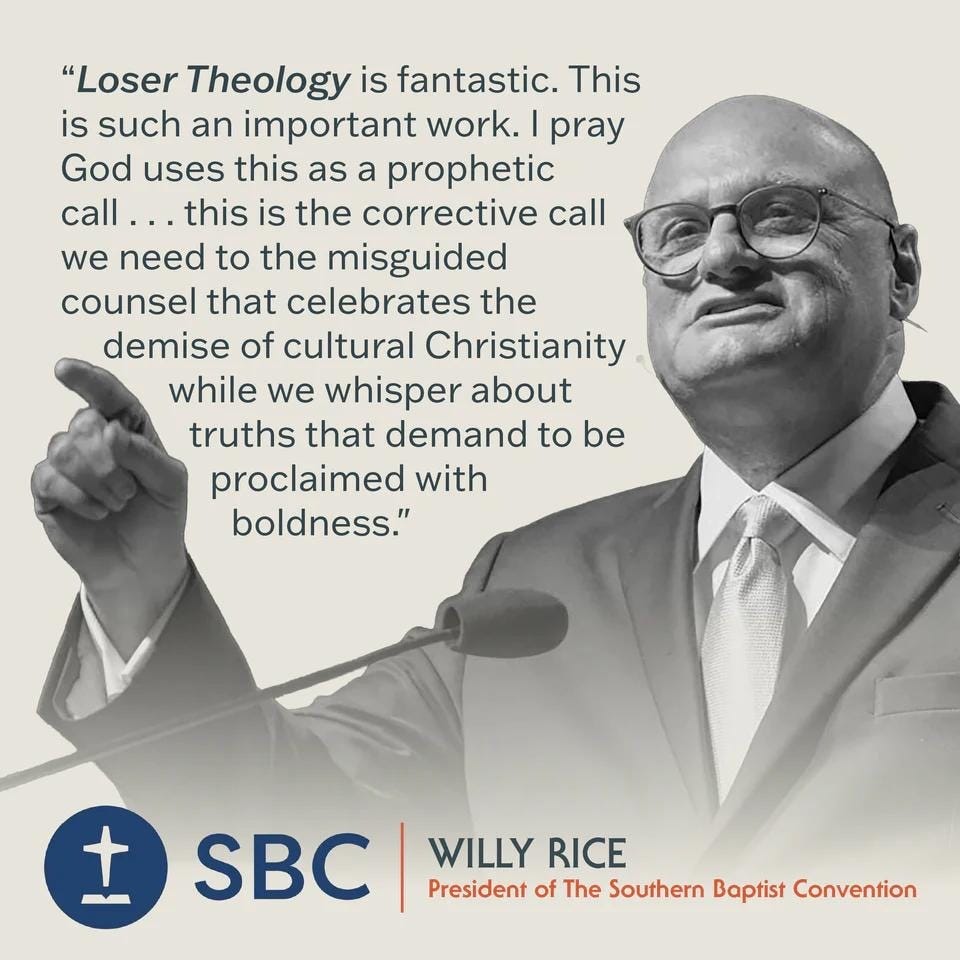
My new book, Loser Theology: Why the Weak Won’t Inherit the Earth, is now available for pre-order! SBC President Willy Rice endorsed the book, saying, “The book is fantastic. This is such an important work. I pray God uses this as a prophetic call… Michael Clary’s book is like a trumpet blast to rouse a sleeping giant. Written from the trenches of real pastoral ministry, it offers a spellbinding diagnosis of what went wrong and a prophetic yet pastoral call for correction. The way of the cross is not capitulating to culture as a victim, but confronting principalities and powers with confidence in the power of God and a willingness to pay the cost of victory.”
You can pre-order it here: www.losertheology.com