

A few years ago, I did some mission work in India with a team from my church that did medical care, evangelism, and theological training for pastors. Being a predominantly Hindu country, I was surprised to notice a bumper sticker about Jesus Christ on the back of a rickshaw (a kind of taxi that is part motorcycle part car). Next to the bumper sticker about Jesus were other stickers representing other Hindu gods to go along with Hindu figurines dangling from the rear view mirror.
According to the Christian ministry leader who hosted our group, this is not a problem for the Hindu faith. Hindus don’t necessarily see themselves as anti-Christian. They don’t reject Christianity by denying Christ directly. Rather, they simply absorb Jesus Christ into their religious pantheon, assigning him to a subordinate status alongside other, higher gods. Hindus may hold Jesus in high regard, even seeing him as a holy man, a prophet, an enlightened guru who taught non-violence and universal love. Mahatma Gandhi was a Hindu leader in India who weaponized Jesus’ teaching on the Sermon on the Mount to recruit Christians to his cause.
I bring this up because a video clip has been circulating of Vivek Ramaswamy on the campaign trail in the Ohio gubernatorial race where he was discussing his faith with a Christian man. This race matters to me because I live in Cincinnati, Ohio, as do many members of my church, and I’m a Christian and a pastor.
He said this:
“In our faith tradition, Jesus Christ is A son of god. I know that is different than saying he’s THE son of God, but that is my view of Jesus Christ… Do we worship [him] in churches? Yes, we do. Is that compatible with our faith? Yes, it is. One true god, in many forms.”


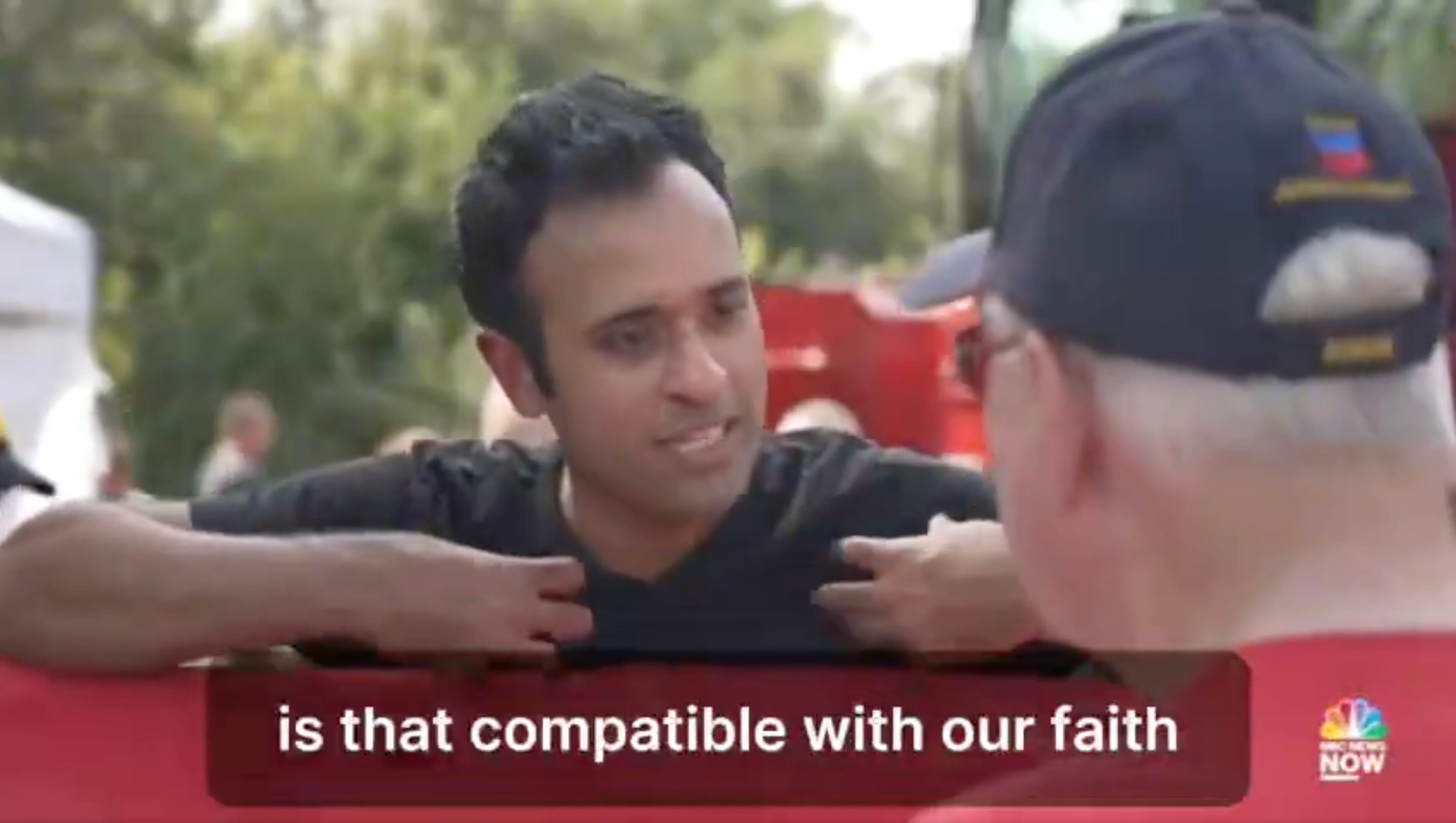
Ramaswamy is an intelligent and successful man. He knows he’ll need the support of conservative Christians to win the governor’s race in Ohio. Ramaswamy uses sophistry to describe his view in terms that Christians are more likely to accept. He doesn’t say, “here’s what we Hindus believe,” he says, “in our faith tradition.” He claims his views of Jesus Christ are “compatible with the Christian faith.”
The ambiguity is doing a lot of work there. He also makes a reference to Hindus worshiping Jesus “in churches.” “Church” is a Christian word. Hindus don’t gather in churches for worship, they go to Hindu temples.

Ramaswamy is deliberately obscuring his true beliefs to appeal to conservative voters who wouldn’t like them if they knew what he truly believed. And he’s campaigning as a conservative Republican whose own worldview would make it difficult if not impossible for him to conserve what conservatives want conserved. His words reveal the Hindu absorption mechanism at work in his campaign. He isn’t articulating the cavernous distinctions between Hinduism and Christianity, he’s blurring the lines in ways that make them seem like negligible, semantic differences.
Christianity simply will not blend with any other faith. It’s a direct violation of the first commandment: “You shall have no other gods before me” (Ex 20:3). Hinduism is a polytheistic faith that acknowledges at least 33 major gods (some argue Hinduism’s gods range in the millions). Ramaswamy cleverly obscures this fact by claiming to believe in “one true god in many forms,” which sounds closer to monotheism, thus closing the gap between them. But even if one were to grant the point, Hinduism’s cosmology is pantheistic–ultimately, everything is god. The sun, moon, stars, plants, animals, trees, birds, and the device you’re reading this article on is ultimately god. The creation account of Genesis 1 clearly establishes the Creator/creature distinction, where God is supreme and eternal who created a realm that is distinct from him. Pantheism is an ancient error of paganism that God corrected in Moses’ creation account.
Despite Ramaswamy’s attempts to blur and obscure Hinduism’s true beliefs, it is nevertheless a polytheistic religion, and pluralism is the natural worldview it produces. But America was not built as a pluralistic society. It was built as a Christian society, which is what made it arguably the freest and most prosperous nation in history. Even the blessed religious freedom we cherish in America was originally intended as a measure to prevent denominational differences between Christians from becoming violent. The men who wrote these protections into our constitution weren’t envisioning a pluralistic public square so Vishnu worshipers could hold public office. They were thinking about how to navigate a specifically Christian public square that could account for different kinds of legitimate Christians, such as presbyterians, congregationalists, and baptists. It was not an open door for Hindus to cheapen our faith, demote our Lord and savior, and lecture Christians about who Jesus really is.

That’s not to say every one of the founding fathers were born again Christians, because that’s not the case. What I’m saying is that the architects of our government were all operating within a Christian worldview and applying the principles of Christianity to government, even though they may not have personally been regenerate believers. You don’t have to be a regenerate Christian to work within a Christian framework, because many of the founders did just that.
That’s why many are questioning Ramaswamy’s conservative credentials since his worldview rejects the very Christian foundation we need to conserve. Put differently, he may be a conservative regarding the fruits of our Christian society, but he’s trying to replace the foundation that’s holding it together. And a faulty foundation won’t last. Ramaswamy’s vision of America is similar to his vision of Christianity. By his own admission, Christianity can be absorbed into and be ultimately replaced by a foreign religion that can speak the language and ape the outer forms but is running on a completely different operating system. Similarly, his vision of America is one that will absorb the people and place that America is built upon and absorb it into the political version of Hinduism–a pantheon of various ideas held together by a precommitment to pluralism. That’s not the America our founding fathers envisioned. If you replace the root, the fruit cannot survive either.
Thus, Ramaswamy might be a conservative in some sense, but “conservatism” as a political philosophy is only as good as what its conserving. And in his case, he’s only capable of conserving a few policies Republican voters might find favorable, but divorced from the robust, Christian worldview from which they arose in the first place.
Don’t get me wrong, I’m not saying Ramaswamy doesn’t have any good policy positions. I’d probably agree with him in many areas. My main concern is this: Vivek may sound like a conservative, but we should be more discerning about who is worthy of that label and what it means.
In short, a man whose worldview functionally demotes Jesus Christ while elevating pagan Hindu gods is not equipped to conserve what matters most. We don’t need conservatives who will simply conserve Reagan era policies that didn’t have the teeth to prevent the chaos we’re living in today. We need to go back further. Much further. Ramaswamy may use our words, and even pretend to respect our religion, but he’s not the man who will conserve the root and foundation of everything that made America great, namely, Jesus Christ himself and the application of the Christian faith to civic life.
America needs leaders who hold good policy positions but also know why they’re good policies, not merely that they’re the right policies that make one electable in a red state. What needs conserving in American life is not a matter of lower taxes, smaller government, school choice, or any other policy Republicans would support, it’s more foundational than that. What needs conserving is a way of life built upon a shared commitment to the Lordship of Christ over all things. The policy commitments that arise from that foundational commitment are important, but we are fools if we believe we can conserve good policies without understanding where they came from. Hinduism that’s presented as a friendly alternative to Christianity won’t cut it.
Excellent analysis, as always!
"The men who wrote these protections into our constitution weren’t envisioning a pluralistic public square so Vishnu worshipers could hold public office."
Some of them actually did. George Washington literally said that civil rights shouldn't just apply to Christians but also to Jews, Muslims and pagans.