

My latest for the Center for Baptist Leadership, reproduced here in its entirety.
The midterm elections are next week. Between now and then, most churchgoing Christians will hear nothing from their pulpits about the choices on their ballots. Many pastors will consider silence as a mark of faithfulness—an indicator that they’re being noble, dignified, and staying above the fray.
This is one of the main reasons why so many evangelicals either don’t know how or why to vote, or don’t vote at all. Silence in the pulpit on political issues and the importance and purpose of voting is probably a large reason why reports show an estimated 40 million Christians in America don’t even bother to get to the polls.
If Christians are not instructed in political matters from the pulpit, why would they prioritize being involved? And if they do vote, many will vote like they’re electing a church officer or picking a pastor. They’ll throw their support behind whoever seems nice and makes them feel good. They may even choose a leftist pro-abortion and pro-LGBTQ candidate like James Talarico in Texas, a seminarian who talks about Jesus frequently and warmly. They do so because he seems “nice” and like he “really cares.”
Meanwhile, they’ll reject a bold, principled conservative leader because that kind of man may seem arrogant or “unloving.”
Scripture gives us qualifications for elders, and they’re almost entirely about character (1 Tim 3:1-7, Titus 1:5-9). Character matters in rulers too (Exod 18:21). But a civil magistrate has a different job description than an elder. An elder’s job is to lead a church, preach God’s word, and shepherd souls. A civil magistrate’s job is to promote justice. Paul calls him “God’s servant for your good,” noting that he “does not bear the sword in vain” (Rom 13:4).
Many political candidates have friendly personalities but wicked agendas. And many political candidates have righteous agendas, even if they themselves are sinners (as we all are) or are aggressively painted by the liberal media as “mean” or falsely accused of being “racist” simply because they want to close our border and deport illegal aliens.
Far too often, Christians get seduced by the warmth of their demeanor and fail to notice the abhorrence of their policies. They vote for what feels good over what makes sense.
Politics Is War
Here’s the main problem with most political engagement for Christians: we approach politics as though it were a church business meeting. We think politics is all about making sure everyone feels heard. We regard conflict and sharp disagreement as a sign of spiritual immaturity. The most important thing is that we build consensus and nobody leaves upset.
That’s a mistake.
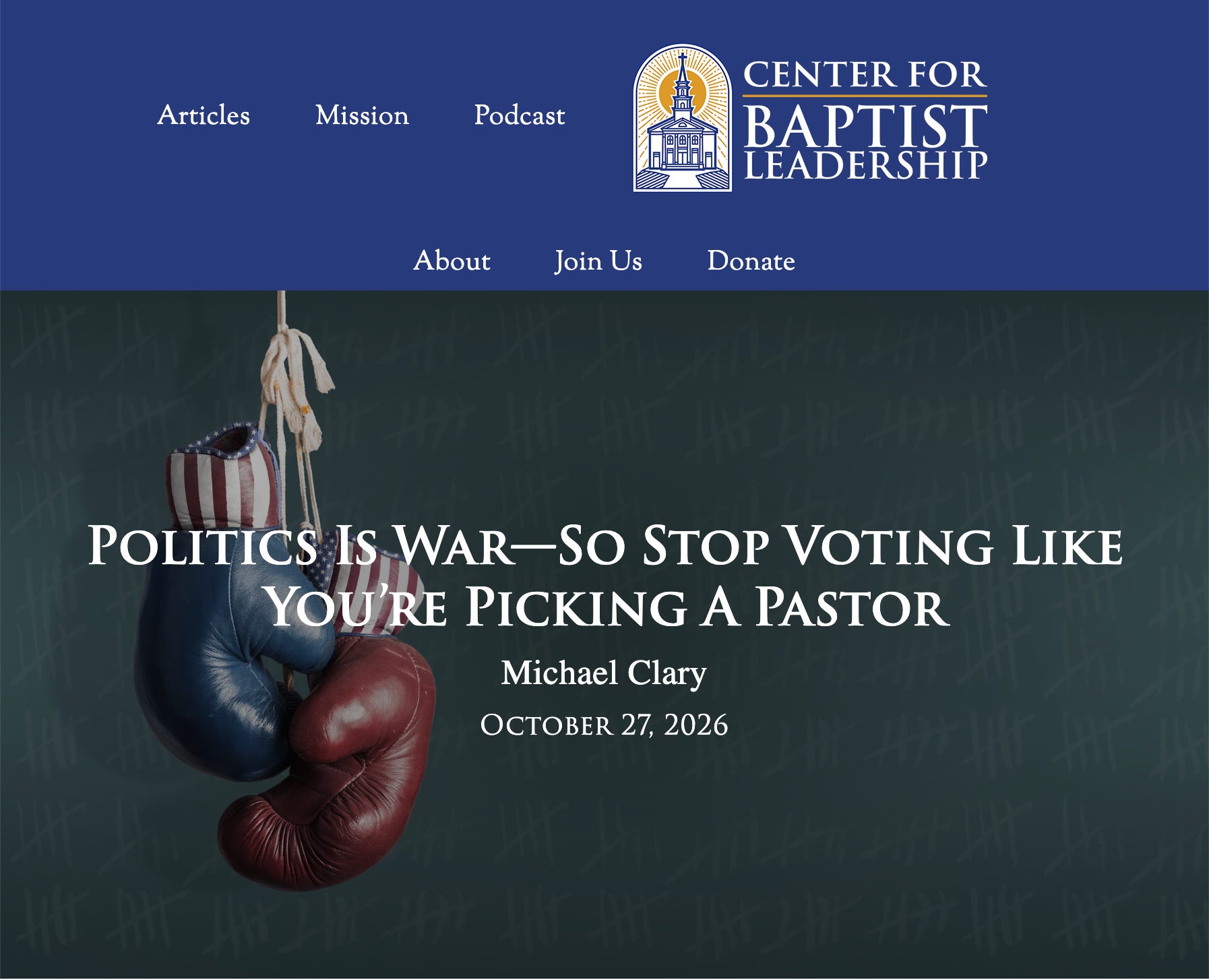
Politics is not a church business meeting. Politics is war. It’s a clash of power, vision, and worldview. The political process is messy, confrontational, and morally demanding. The ugliness of politics can make it feel dirty, especially for Christians with pietistic sensibilities.
Many Christians can’t stomach this. Neither can their pastors. It doesn’t feel very Christlike. We assume loving our enemies means never opposing them. Jesus’ earthly mission centered on the cross, but he endured the cross to secure the crown (Heb 12:2). When pastors forget this, they avoid laying out a biblical vision for a just society. They fail to teach about the blood-and-iron realities of governing. As a result, their civic engagement shrinks to voting every two years while staying otherwise silent on these matters. In my book, Loser Theology, I call this posture “White Flag Christianity.” White Flag Christianity equates cultural surrender with faithful witness.
White Flag Christianity produces politically neutered pulpits, contributing to a society that is pathologically soft, sentimental, and morally confused. Societies like this are self-destructive. They take the side of criminals over the victims they harm, somehow convinced that punishing wicked behavior is unfair, unethical, and unChristlike.
Keys and Sword
Where does this problem come from? Part of it comes from a poor doctrine of the church and how it relates to the state. Many Christians think of the church as a pilgrim minority passing through a foreign land. If that’s true, the state is essentially the landlord. And good tenants pay their rent on time and don’t demand much from their landlords.
In this view, the church’s job is to stay out of the way, keep its head down, and confine its influence to the souls of individual believers. Christian political engagement then gets recast as a category error: the church shouldn’t meddle in Caesar’s affairs. Those things are considered worldly.
This results in a church that has almost entirely privatized the faith, accepting a false division of labor where the state governs all matters of public life and the church manages private spirituality. This isn’t biblical. This is tantamount to a surrender agreement that hands the state jurisdiction over all practical matters while the church tends to feelings and eternal destinations.
The Scriptures instruct us about how the church should relate to the state by distinguishing different kinds of authorities. The local church has the keys of the kingdom (Matt 16:19), with binding and loosing authority according to the spiritual needs of her people. The state has the power of the sword (Rom 13:4), with authority to enforce justice in society, even if it requires the use of violence.
Christians are free to participate in both the ecclesial realm and the civil realm as long as we maintain this distinction.
Charles Spurgeon had no problem with Christians being involved in politics. He said, “I often hear it said ‘Do not bring religion into politics.’ This is precisely where it ought to be brought, and set there in the face of all men as on a candlestick.”1 Spurgeon is right. Christians can and should be involved in politics, provided we make the proper distinctions.
Simply put, politics isn’t church. The elders’ duty is to shepherd souls. The magistrate’s duty is to manage society. The church proclaims the grace of Christ. The state executes public justice. When each sphere stays in its lane, both can thrive. When these spheres get blurred, both will suffer.
But distinguishing the spheres doesn’t mean the pulpit goes quiet about the sword. The pastor doesn’t wield it, but he must teach what God requires of those who do. Romans 13 is in the Bible, and it’s meant to be preached.
Let me give you a practical example. Suppose a church has a lay elder who is also a police officer. As a policeman, his duty is to uphold the law. As a church elder, his duty is to minister the gospel of grace. He can do both faithfully as long as he doesn’t confuse the two.
Now, suppose a man in his church breaks the law. What must he do? He must arrest that man. It would be unjust to show a guilty man leniency because he’s a fellow church member. But when that man gets out of jail and comes back to church with a repentant heart, the elder can gladly minister the grace of God to him. It would be wrong to bar him from the Lord’s table.
One man, two roles, properly distinguished. Christians can participate in both realms. When we don’t make these distinctions, we allow the spiritual duties to overshadow the civil duties, thus leaving us with no political vision at all.
What to Do on Election Day
So what should you do before November 3?
Make a plan to vote, obviously. But don’t stop at the name at the top of the ticket. There are down ballot races that will also have an effect on your daily life more than you might think. Though Donald Trump is currently the President, I live in Democrat-run inner-city Cincinnati (though my church is located in Fort Thomas, KY). I can assure you local politics has a major effect on my daily life that is beyond the President’s control. It’s the same for all of us.
Pay attention to state legislators, county prosecutors, judges, and school board members. Look up who’s running. Read what they’ve said and what their party’s platform commits them to.
Then ask the questions the Scripture asks of civil magistrates and rulers. Will this person work to restrain evil? Or will they put wicked people back on the streets? Will they enforce justice or not? Will they protect the innocent? Will they uphold what God calls good or will they promote evil?
After all the votes are counted, then we have a duty to pray for our elected leaders. Regardless of whether you voted for them, you should pray for them by name, as Paul commands (1 Tim 2:1–2).
Remember, politics is the realm of justice. The state wields the sword to restrain evil and promote good (Rom 13:4; 1 Pet 2:13–14). Wicked people have no fear of God. They have no limiting principles. They are not restrained by virtue. They just want to win. We must do what we can to stop them.
Four centuries before Christ, Plato made a profound observation that still rings true today. In the Republic, Socrates argues that the greatest penalty for refusing to rule is to be ruled by someone worse.2 If we refuse to punish evil, evil will punish us. Christian love does not tolerate evil; it opposes it.
Thus, sometimes the best way to love our enemies is to defeat them—starting at the ballot box.
1 C. H. Spurgeon, “The Candle” (sermon no. 1594, April 24, 1881), Metropolitan Tabernacle Pulpit, vol. 27.
2 Plato, Republic 1.347c.
Soooo good! Amen!