

Why Christians Struggle to Think Clearly Under Pressure
We live in an age saturated with information, urgency, and moral pressure. Christians are constantly told what to fear, what to celebrate, and how quickly we must respond. Without realizing it, these factors form our habits of thought and action. This essay is not an attempt to relitigate culture-war skirmishes or assign new enemies. Rather, it is an effort to name how propaganda works on all of us, how it bypasses judgment, and why Christians who sincerely want to be faithful must learn to slow down, think clearly, and resist being trained to act without wisdom.

Here’s the painful reality: Christians who read their Bibles, uphold the truth, and distrust the world often think they are immune to propaganda. They assume propaganda only works on ignorant, immoral, and unserious people. This assumption is false. In this essay, I’m going to explain why faithful, Bible-believing, godly Christians can be even more susceptible to propaganda than your average person.
Propaganda is all around us and arrives in a variety of ideological packages. Progressive propaganda typically relies on narrative construction, often detached from reality. Conservative propaganda is different. It borrows real truths, exaggerates legitimate concerns, and uses them to demand tribal loyalty or suppress good judgment.
Personally, I’m committed to the truth of Scripture. I want to believe what is true and right, no matter what, even if it’s personally costly. Over time, I’ve gotten pretty good at recognizing and resisting leftist propaganda. But conservative propaganda is harder to detect, because conservatism is what I believe and the world I inhabit. It’s my tribe. So, the challenge is not only discerning propaganda from the Left, but also from within my own camp.
That’s the difficult thing for conservatives to admit: we use propaganda too. Not mainly to persuade outsiders, but to police boundaries and behaviors within the tribe. And conservatives are more susceptible to conservative propaganda because our coalition claims to value truth.
Conservatives propagandize one another because some are jockeying for position within the coalition. Sometimes they’re driven by ambition. Sometimes by money. Conservative propagandists profit from the genuine concerns and legitimate fears of sincere believers. In an age of thick lies, how can we discern truth from error? How can we know if outside actors are exploiting us to sow division and confusion? When someone comes along claiming to have uncovered the “real truth” about some issue, how can we know if they’re trustworthy or not?
It’s a cold, hard fact of modern life. Propaganda is everywhere, and we’d be fools to think we’re immune to it. And conservative Christians who think they are “red pilled” can be even more vulnerable to propaganda, precisely because they think we always see things clearly. We are not vulnerable because we reject the truth, but because our commitment to truth convinces us we are immune to manipulation. Then, we end up acting on impulses supplied by propaganda while sincerely believing we’re acting on Christian principles.
Propaganda is a system of social conditioning aimed at producing conformity of action and thought through emotional pressure, repetition, and total immersion in a controlled symbolic world. It is difficult to resist, or even detect, because of its sheer size, scope, and omnipresence, all of which are amplified by modern technology and mass communication. That is the mechanism, and it explains far more about modern Christian confusion than most people are willing to admit.
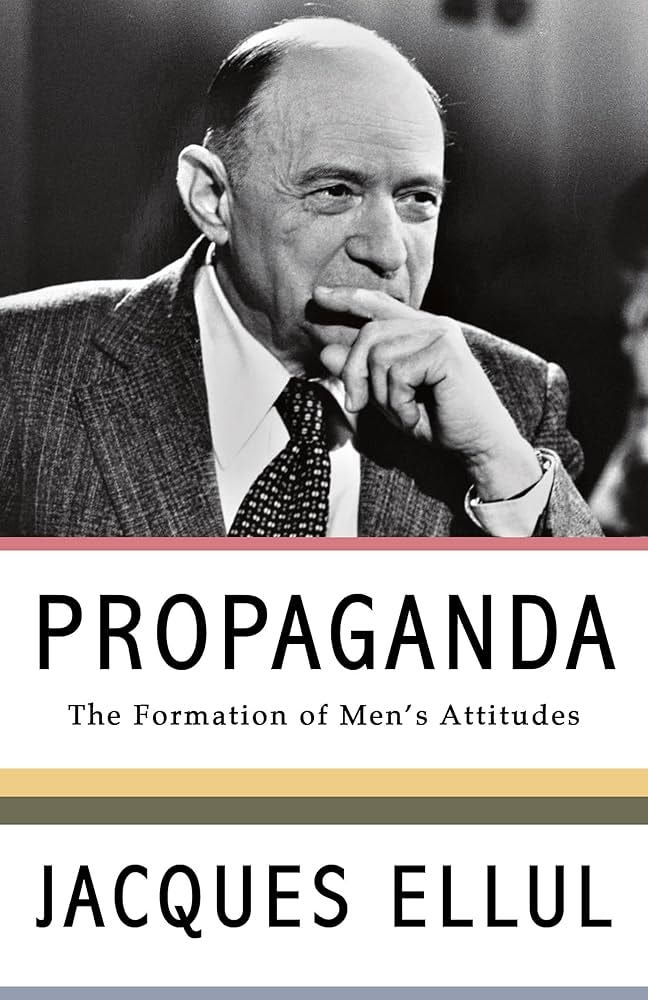
What follows are eight realities about propaganda that can help you discern and resist it. Before going any further, I need to name my source. These insights are drawn primarily from Jacques Ellul’s important book Propaganda: The Formation of Men’s Attitudes (1963). I am not an Ellul scholar, and this essay is not a summary of his book. I’m simply a pastor trying to help Christians learn how propaganda works so we can resist its manipulative power more faithfully.
1. Propaganda Aims to Provoke Action Without Reflection
Most people think propaganda is about falsehood, such as fabricated claims, obvious lies, and crude manipulation. That’s not true. The best propaganda doesn’t lie overtly, because propaganda is chiefly interested in compliance. Propaganda’s goal is to move you, hurry you, shame you, flatter you, or frighten you until the actions you take as a result feel like Spirit-led instincts which you later justify with changed beliefs. Thus, the ultimate aim of all propaganda is to provoke action without prior thought.
The most effective propaganda relies on selectively curated facts. Those facts are carefully selected, exaggerated, framed, and arranged into a narrative that gives emotional coherence to scattered data. Ellul writes, “Facts are treated in such a fashion that they draw their listener into an irresistible sociological current… propaganda must be based on some truth that can be said in few words and is able to linger in the collective consciousness” (p 55). In other words, propaganda’s favorite facts are memorable and sensational.
Propaganda trains us to act first and reflect later. The goal is to get people involved. It can even be small actions, like “wear this ribbon,” “put this frame on your profile picture,” or “share this clip.” Once the desired action is secured, our beliefs will follow to justify the actions we’ve already taken. Ideally, the action will be public, making it part of your identity. Everyone saw what you did. At that point, you are psychologically invested. You retroactively align your beliefs to justify what you’ve already done.
Once this happens, arguments stop functioning as truth claims. They become action-defenders instead. Reasoning becomes a tool to protect past behavior. As Ellul puts it, “Action makes propaganda’s effect irreversible… He who acts in obedience to propaganda can never go back” (p 27). Whenever discernment is replaced by urgency, emotion, or moral pressure, propaganda has already won.
2. Propaganda Simplifies Reality Through Moral Compression
Propaganda thrives in morally charged environments, especially when reality is complex. And propaganda is most effective when it provides simple explanations for complex realities.
Modern society produces information overload, making it impossible to process and reflect on the news of the day. Propaganda offers relief by providing simple explanations for complicated problems. It gives people an all-encompassing moral map and a clear way to signal allegiance.
Simplicity is essential. Propaganda cannot tolerate complexity because complexity slows people down. Careful reflection takes time, and propaganda needs momentum. So reality is compressed into rigid moral binaries: good versus evil, victim versus oppressor, ally versus enemy. This is not accidental. Mass compliance requires moral compression.
Once these categories are established, questioning them becomes an act of betrayal. That’s because propaganda is not about evaluating ideas. It’s about taking sides. And once people are divided into “good guys” and “bad guys,” self-righteousness becomes extreme and irrational. Ellul notes that the propagandist must insist on the purity of his own intentions while hurling accusations at the enemy.
Projection becomes a standard tactic. Ellul observes that propagandists often accuse their enemies of precisely the intentions they themselves possess. Those preparing for domination accuse others of tyranny. Those seeking conflict loudly proclaim their peaceful motives. The accusation itself reveals the accuser’s aims.
3. Propaganda is Driven by Moral Urgency
Propaganda is most effective on moral people who care and want to do good. It works by attaching itself to an individual’s existing moral instincts, such as justice or compassion, and weaponizing them. Propaganda needs its causes to feel righteous and urgent. Sober-minded reflection becomes an obstruction in a morally urgent cause. Urgency is the mechanism propaganda uses to demand impulsive action.
This is why propaganda opportunistically seizes current headlines to demand immediate action. The “current events man” is its ideal target. To discern the wisdom of an action is considered a delay, and delay is the same as harm. “Justice delayed is justice denied,” they’ll say. “We can’t just sit by and do nothing while people are suffering! Something must be done!” Not taking the prescribed action feels immoral.
Propaganda borrows the vocabulary of goodness and turns it into a lever used to exert moral pressure. Christians are especially vulnerable here because we care about righteousness, justice, mercy, and love. But Scripture never sanctifies hasty, bad decisions because someone’s heart was in the right place. Love “rejoices with the truth” (1 Cor 13:6). When moral language is used to demand compliance apart from cultivated wisdom, propaganda is already at work.
4. Propaganda Treats Emotion as Evidence
Once propaganda has attached itself to a cause and simplified reality through moral compression, it leans hard on primal emotions, such as fear, shame, outrage, and sympathy. These emotions are not simply responses to facts. Emotions are the facts. Propaganda is not interested in what is true, only what feels true. Emotion is regarded as evidence. Emotional satisfaction is the measure of reality.
A propagandist can misleadingly edit a video clip to provoke an emotional reaction. The emotional impact of the clip will be significant as it goes viral. The nuanced corrections and retractions that appear later will go largely unnoticed. Everyone has already gotten drunk on the outrage. Thus, if someone feels harmed, the claim is authoritative. Why? Because their emotions are all the evidence needed to verify the claim. To question the inerrancy of someone’s pain is to commit violence. Ellul says, “modern man does not think about current problems; he feels them. He reacts, but he does not understand them any more than he takes responsibility for them” (p 47).
Since emotions eclipse reason as a validating factor, rational thought and consistency go out the window. When emotions dictate the reality everyone is living in, facts are irrelevant. Facts simply won’t move the needle in a cognitive system that uses emotions as sufficient evidence. Since emotions are often irrational, irrationality becomes a key feature of propaganda. Irrationality can even make the matter feel more real. As Ellul says, “The skillful propagandist will seek to obtain action without demanding consistency, without fighting prejudices and images, by taking his stance deliberately on inconsistencies” (p 35).
Ironically, irrational contradictions can reinforce the power of propaganda. Ellul continues, “It is always surprising that the content of propaganda can be so inconsistent that it can approve today what it condemned yesterday” (p 18). Since people don’t have the time or mental space to evaluate each news story closely, we just accept what we’re told, regardless of the inconsistencies or hypocrisy involved.
5. Propaganda Works Best on Moral, Educated People
Propaganda works best on educated, moral, and sincere people. They think they are immune to it. That’s because people who are confident in their goodness and intelligence are less guarded. They have lower defenses because they think they are too smart to be deceived. Their moral and intellectual confidence is precisely what makes them vulnerable to propaganda.
This is arguably Ellul’s most unsettling insight. The people most susceptible to propaganda are intelligent, educated, follow the news closely, and are convinced they are impervious to it. Educated people assume they are thinking freely, unaware that they are being steered by propaganda. Ignorant people, on the other hand, know they are vulnerable, so they are more likely to be on guard.
Christians who read widely, follow the news, listen to podcasts, and take pride in being informed assume they are discerning. They think they can’t be deceived because they know all the latest trends and follow the controversies closely. They’ve read the articles, listened to the podcasts, and absorbed all the data. They think more information makes them wiser. More likely, it makes them overwhelmed and exhausted. Being overwhelmed and exhausted makes people more vulnerable to simple, all-encompassing explanations.
Ironically, not even intelligence is a sufficient shield against propaganda. Highly intelligent people can more adeptly justify their bad instincts. They confuse intelligence with wisdom, making them more vulnerable to elite propaganda that is cleaner, subtler, and more ego-flattering. Propaganda feeds on intellectual arrogance. Most people lack the intellectual humility to read slowly, think critically, and honestly admit, “I don’t know.” Uncertainty is distressing. We find comfort in intellectual certainty, even though it may be unwarranted.
6. Propaganda Functions Like a Church
Propaganda functions like a church, offering answers to the most emotionally distressing problems of modern life. Propaganda tells you who you are and what to believe; it gives you a tribe to belong to, a moral cause to join, and villains to despise. In this way, propaganda functions like a church and enjoys the same levels of religious devotion.
Ellul notes that one of man’s deepest needs is to feel that he is right—right in his own eyes and right in the eyes of others. Propaganda supplies that feeling of righteousness. It assures the individual that his cause is just and his actions are good.
Propaganda also supplies enemies. It legitimizes hatred by framing it as a moral duty. Hatred becomes righteous, and violence is justified (cf Isa 5:20). Finally, propaganda resolves anxiety by offering a total explanation of the world. Nothing is mysterious anymore. Everything fits the narrative.
In these ways, propaganda takes the place of religion in people’s lives. It makes you feel righteous. You belong to the “right” group. You support the “right” cause. In a chaotic world, this is psychologically comforting. You don’t accept it because it’s true; you accept it because you derive identity and purpose from it.
7. Propaganda Cannot Be Defeated by Information Alone
A common mistake people make, especially conservatives, is to assume that speaking the truth is all one needs to defeat propaganda. Conservatives are people who care about truth, so when we see the deceptive power of propaganda, we assume we can make arguments and use truth to overcome it. We assume the correct information, using facts and logic, will dislodge propaganda from another’s mind. That’s not true. It won’t work.
Propaganda works by “flooding the zone” with information. Ironically, adding more facts can strengthen propaganda by overwhelming the hearer, driving them to retreat to simplistic explanations and conclusions presupposed by propaganda. A propagandized man will hear logical facts and arguments and think, “This is just another power play to control me.” Information without formation exhausts people, and exhausted people comply with propaganda. It just feels safer.
This is why endless articles, explainers, and “awareness” campaigns rarely clarify anything. They just keep people anxious and emotionally elevated. Then, they calcify in their original positions and seek refuge in their “church,” which is a heavily propagandized ideological community. Simply put, more content is not enough to dislodge propaganda, even if it’s true. Propaganda must be dislodged through spiritual formation, which is a virtue cultivated over time.
8. Discerning Propaganda Begins by Acknowledging Our Complicity
Here’s the hard truth: you have been deceived by propaganda. So have I. We all have. Propaganda is everywhere. None of us stands above it.
And don’t think you’re immune to it because you’re a red-pilled, Bible-believing, conservative Christian. Lots of people who are heavily propagandized fit that description. Being a Christian who believes the Bible doesn’t grant you immunity. I’ll admit that’s a hard reality to face, but it is a crucial step towards growing in discernment. Are we so arrogant to assume we’re never wrong? Are we so blind to our human frailty or our propensity to be emotional thinkers?
Enough of the bad news. Here’s some good news. God sees all things perfectly. And God has equipped us with what we need to grow in discernment if we have the intellectual humility to apply the tools properly. Jesus said, “Do not judge by appearances, but judge with right judgment” (John 7:24).
Humility is the first defense. Discerning propaganda begins with accepting that it is everywhere and unavoidable, and that we have all been propagandized to a degree. Thus, to see the world more clearly, we must first see ourselves more clearly (Rom 12:2). We must see that we have been manipulated by propaganda, and then, more painfully, we must admit that we have even participated in it.
Discernment is not just another technique. It is a way of seeing. One must intentionally choose to slow down, soberly reflect before rushing to judgment, and resist taking impulsive action. Unfortunately, we no longer live in a high-trust society where we can trust the experts. Discernment cannot be outsourced to others; it is something individuals must cultivate. Further, discernment is a skill that can be acquired and sharpened through practice (Heb 5:11-14). Scripture tells us to “test everything; hold fast what is good. Abstain from every form of evil” (1 Thes 5:22). Ultimately, the most discerning people will be those whose loves, loyalties, and judgments have been slowly shaped by Scripture, worship, spiritual maturity, and the fear of God.
A Final Word
Jacques Ellul warned that propaganda is a permanent feature of technological society. The modern man is the most propagandized man. If Ellul was right, and I believe he was, then the church’s task is not to out-shout propaganda, or out-inform it, but to form and train people to not be so easily moved by it.
Christians serve a King who is Lord over propaganda. And the church was designed to resist precisely this kind of moral manipulation by forming people who can wait, judge, and obey God rather than the moment. Discernment is not a skill you pull out occasionally when you need it. It is a habit you cultivate long before the pressure arrives. The most discerning people will discipline themselves to resist propaganda and help their churches resist ideological fads. As the people of God, they will work to shape the spiritual instincts of God’s people towards goodness, truth, and beauty.
This piece was originally posted at The Center for Baptist Leadership.
An excellent post!
I would consider myself a 'progressive conservative' after the pattern of Eisenhower. I recognise the need for progress, but also aware of the need to subject 'progress' to careful examination. So I come from a position slightly to your left.
Even so, I agree 100% with what you say. I find that the best way to protect against propaganda is to THINK THROUGH causes and consequences. This matches up with your point that propaganda urges action rather than thought.
It also affects how I research questions. I don't just assess the argument put before me, I also try to find what objections are raised against it. As is said, simple answers are often the quickest, cheapest, easiest and wrongest.
As you say, Bible-believing Christians sometimes being the most vulnerable. This is because too many preachers provide the 'quick, simple answers' that amount to propaganda themselves. Preachers condition their hearers to be more vulnerable, not less! I call this 'proof-texting' an answer instead of coming to grips with the theology underlying it. There are several areas where I have changed my position over the years, and always because I had the spiritual courage to step outside the 'traditional' sheep pen of my particular denomination. For example, Paul's advice to slave-owners and slaves was good advice in a slave-owning society; "Treat them as members of your family!" Because to simply set them free without familial support in a society that wouldn't allow an ex-slave any legal rights against a predatory citizen was effectively to force them to live by crime. Paul's underlying position was that the vulnerable who depend upon you should be respected and protected. This was the ugly side of emancipation in the Reconstruction, as slaves were 'set free' but not protected. The social context today is vastly different. Similar arguments could be raised in areas such as feminism and welfare.
Often this is consciously framed with the loaded question "Do you believe in the inerrancy of the Bible?" I certainly do! I've spent lots of time, money and commitment to understanding it, which I wouldn't do otherwise. But that doesn't mean I believe in the inerrancy of any particular understanding of the Bible. Even commands in the Bible need to consider the context; what does the command "Go and do likewise" mean, except in context? It's genuinely amazing that so many who claim to understand the Bible 'literally' manage to import their own assumptions into the text; and this includes translators! And there's always the excuse "except when it's obviously inappropriate" without any consistent exegetical rule about when it's obviously inappropriate. 'Day' means '24 hours' in the first chapters of Genesis, except when God says 'On the day you eat of it'.
So I agree with you, and suggest one immediate step as at least partial protection. Always ask yourself "Does the other side's argument have ANY merit, and exactly what assumptions am I making that I can't justify? If so, how can I integrate that merit into my own position and eliminate my disconnects?"
This make me think of college educated white women.