The following is adapted from a talk I gave to the men of my church.
When I was first assessed as a church planter around 2007, they said I had one weakness in particular that would hinder me as a pastor and church planter.
I didn’t take criticism well.
I was offended when I heard that feedback, which only proved their point. It was a problem that I would have to figure out, one way or another, if I was going to make it in ministry.
That was nearly twenty years ago. I can now say without hesitation that any man who can’t handle criticism is not ready to be a pastor. He’s too soft, and that’s a vulnerability the Enemy will surely exploit.
It’s not just a pastor thing, it’s a basic discipleship thing. You need mental toughness to be faithful to God. Mentally weak people will be “tossed to and fro by the waves and carried about by every wind of doctrine” (Eph 4:14). Mentally tough people will “contend for the faith that was once for all delivered to the saints” (Jude 3).
A few men are born with it. The rest of us develop it by discipline or by going through trials. God uses both to strengthen us mentally.
Mental toughness doesn’t mean being cold, stoic, or emotionless. We’re humans, not robots, and God made us capable of feeling a broad range of emotions. Being mentally tough is about not letting your emotions rule your life, especially when you feel like giving up. A mentally tough man doesn’t fall apart when life hits him hard. He can absorb bad news without spiraling into despair. He can receive criticism without pouting like a baby. He can keep going when everything within him wants to quit.
Proverbs 24:10 says, “If you faint in the day of adversity, your strength is small.” That verse assumes days of adversity are coming, and those days show who you actually are. When the day of adversity comes (and you know it will), the strong man holds frame and keeps his nerve. But the weak man “faints.” He despairs and falls to pieces because his “strength is small.”
Is that you? Is your strength small? If it is, take heart. That text is not in your Bible to mock you for being weak. It’s there to diagnose your condition so you can get better. That’s what this essay is about—getting better.
There are at least four warning signs we can glean from the Proverbs, and there’s a way out of all of them.
#1: The Mentally Weak Man is Easily Offended
Proverbs 19:11 says, “Good sense makes one slow to anger, and it is his glory to overlook an offense.”
Some people really do like being offended. It starts out as a habit, but over time it can turn into a hobby. I know one woman who has held on to petty childhood grievances for several decades. She is miserable, and strangely seems to enjoy the misery.
Some people tend to their grievances like the curator of a museum. Ancient insults are kept behind glass, brightly lit for all to see.
Our culture incentivizes this. We train people to be irresponsible and emotionally immature by rewarding those who are easily offended. Grievance has become a form of currency. The more wounded you are, the more you’re owed.
Most of the time, we’re not offended because someone has committed a sin against us. We just feel slighted in some way, often due to a simple miscommunication or misunderstanding. We get offended because our ego took a hit, and most of us could stand to have our egos bruised from time to time.
Notice again what Proverbs 19:11 says: overlooking an offense is glorious. Offensive things will certainly happen, but you have the choice whether to overlook it or let it ruin your day. There is no law requiring you to take it personally.
Think about how much mental energy it takes to get offended. Most of the time, it’s over something dumb, yet you let it consume your thoughts. That’s just your pride getting you worked up. You’re offended because you want to be.
So the next time you feel the urge, you can choose to overlook it. Make a deliberate decision, telling yourself, “I’m not going to respond. I’m not going to say anything. I’m going to act like everything is fine.” You can’t always control the feeling, but you can control your response.
If someone really has sinned against you, that’s a different matter. Scripture tells you what to do about that in Matthew 18. Go to him directly and deal with it. But let’s be honest—most of the time, it’s not that serious, and we can do everyone a favor by just learning to let it go.
#2: The Mentally Weak Man Can’t Control His Anger
Proverbs 16:32 says, “Whoever is slow to anger is better than the mighty, and he who rules his spirit than he who takes a city.” Solomon ranks the man who is “slow to anger” above the “mighty” man. There are lots of quick-tempered fools who appear strong because people react to their rage. But the inability to control your temper is a sign of weakness, not strength.
It takes more strength to rule yourself than to take a city. We call that self-control, which is a fruit of the Spirit (Gal 5:22-23). The wise man keeps his mouth shut when he’s angry because that’s when he’s less filtered.
I once heard a man say, “I only have two emotions. Angry and asleep.” Anger is the one emotion a man feels free to express, though his actual emotions can be quite varied. Outrage, indignation, resentment, annoyance, frustration, and bitterness are all forms of anger. We may not always understand our emotions, but we must always keep them under control.
Proverbs 25:28 says, “A man without self-control is like a city broken into and left without walls.” A man who can’t control his anger is unpredictable and unstable because his emotions are running his life. This man cannot be trusted.

Proverbs 29:11 says, “A fool gives full vent to his spirit, but a wise man quietly holds it back.” Any idiot can blow his stack and say things he’ll later regret. He might say, “I’m just venting.” The Bible says that man is a fool. There’s nothing strong about that, even though it can be intimidating for those who witness it.
What’s the solution? You can’t stop yourself from feeling anger, and you shouldn’t even try. That’s neither good nor wise. The solution is to first learn how to restrain your anger, then learn to channel it towards something productive.
Martin Luther learned to do this. He once said, “I never work better than when I am inspired by anger; for when I am angry, I can write, pray, and preach well, for then my whole temperament is quickened, my understanding sharpened, and all mundane vexations and temptations depart.”
In other words, anger can be a gift if you can use it for motivation and focus. It gets our adrenaline going and motivates us to take action. The mentally weak man gets angry and becomes more impulsive. The mentally strong man gets angry and becomes more focused.
#3: The Mentally Weak Man Can’t Take Criticism
Proverbs 15:32 says, “Whoever ignores instruction despises himself, but he who listens to reproof gains intelligence.”
Being thin-skinned hindered my early ministry. Criticism wounded my pride. When we are criticized, our first instinct is to defend ourselves. That’s natural. But if we stay in that place, we’ll be stuck and won’t grow.
The smart thing to do is give criticism its due consideration. Listen to what they have to say and ask yourself, “is there any truth in this?” If so, you can profit from it, even if the person who said it was trying to hurt you.
Antisthenes once said, “There are only two people who can tell you the truth about yourself: an enemy who has lost his temper and a friend who loves you dearly.” Proverbs 27:6 says, “Faithful are the wounds of a friend; profuse are the kisses of an enemy.”
The mentally weak man is too proud to hear it. Proverbs 9:8 says, “Do not reprove a scoffer, or he will hate you; reprove a wise man, and he will love you.” Nobody likes it. Everybody needs it. Wise men receive it. The scoffer protects his ego, but the wise man protects his character. To become strong and wise, you have to be the kind of man people feel safe correcting.
That will take humility. Scripture says, “humble yourselves before the Lord, and he will exalt you” (Jas 4:10, cf 1 Pet 5:6). Humility is an action, not just a temperament. If you want to become stronger, you will not only receive criticism when it comes, but you will deliberately invite it.
Here’s a challenge. Think of a friend you really trust and ask him for a favor. Tell him, “I want to grow as a man and I need your help. I want you to think of two or three things you observe in my life where I need to grow but no one wants to tell me. Don’t hold anything back. Make it sting. I trust you to be brutally honest, and I give you my word that I won’t hold it against you.”
Tell him to think about it for a few days, then have the conversation. After this, two things will happen. First, you’ll find out whether he’s a real friend. Second, he will wound you, and that wound will make you better. Embrace it. Perhaps you’ll discover a blind spot that’s been holding you back.
#4: The Mentally Weak Man Doesn’t Push Through Adversity
Proverbs 24:16 says, “The righteous falls seven times and rises again, but the wicked stumble in times of calamity.” Everyone stumbles and falls sometimes. The difference between the righteous and the wicked is how they respond to it.
A few years ago, I went through the hardest season of my ministry. I experienced extremely high levels of stress, fear, and anxiety. I’d wake up in the middle of the night and be unable to go back to sleep. So I’d go outside and walk around my neighborhood praying. I’d go to some meetings in such a state of panic that I could barely speak.
Even though I love being a pastor, I considered quitting just to escape the stress. But deep down I knew that wasn’t an option. I needed to find a way to keep going. During that season, I prayed more frequently and fervently than perhaps any other time in my life. Even though I don’t miss that season, I do miss the depth of fellowship with God I enjoyed during those days of darkness. In the end, God gave me the strength to keep going.
You’re gonna get knocked down, everyone does. But do you get back up and keep going after that? The mentally strong man refuses to feel sorry for himself or blame others for things within his control.
James 1:2–4 says, “Count it all joy, my brothers, when you meet trials of various kinds, for you know that the testing of your faith produces steadfastness. And let steadfastness have its full effect, that you may be perfect and complete, lacking in nothing.” God uses trials to test our faith, and the testing builds our character over time. We need trials to grow—we won’t become mature any other way.
“Steadfastness” means you don’t buckle under the weight of trial. Mentally weak men shrivel up and tap out. Mentally strong men dig deep, find their courage, and keep going.
Start This Week
The Bible calls out our weakness so we can work, in the power of the Holy Spirit, to become strong. Weakness doesn't disappear on its own; we have to discipline it out of ourselves. Paul said, “I discipline my body and keep it under control” (1 Cor 9:27).
When something offends you, choose to overlook it. And remember, it is your glory to do so.
When something makes you angry, don’t vent it, choose to rule your spirit and restrain it. Then, choose to channel that anger into something productive.
When someone criticizes you, listen to what they say and choose to not get defensive. Even your sharpest critics can be of benefit to you because they’re not worried about sparing your feelings.
And when you get knocked down, choose to get back up and keep going.
Proverbs 4:23 says, “Keep your heart with all vigilance, for from it flow the springs of life.” Everything else in a man's life flows from there, so that is where the guarding has to start.
Loser Theology Book
Loser Theology came out a little over a month ago.
(Quick note about Amazon preorders: a warehouse mix-up delayed a batch of early orders placed in August and September. If yours hasn't arrived, send me a DM and I'll send you a free Kindle copy while you wait. New orders from Amazon and Canon are shipping normally.)
The book has been positively reviewed in major publications, such as World and American Reformer. I've been told to expect at least one more review in a major publication later this year.
Reader reviews on Goodreads and Amazon are looking pretty strong so far. If you’ve read the book and liked it, please give it a review!
Also, here’s a fun conversation about the book I recently had with Doug Wilson and Joe Rigney.
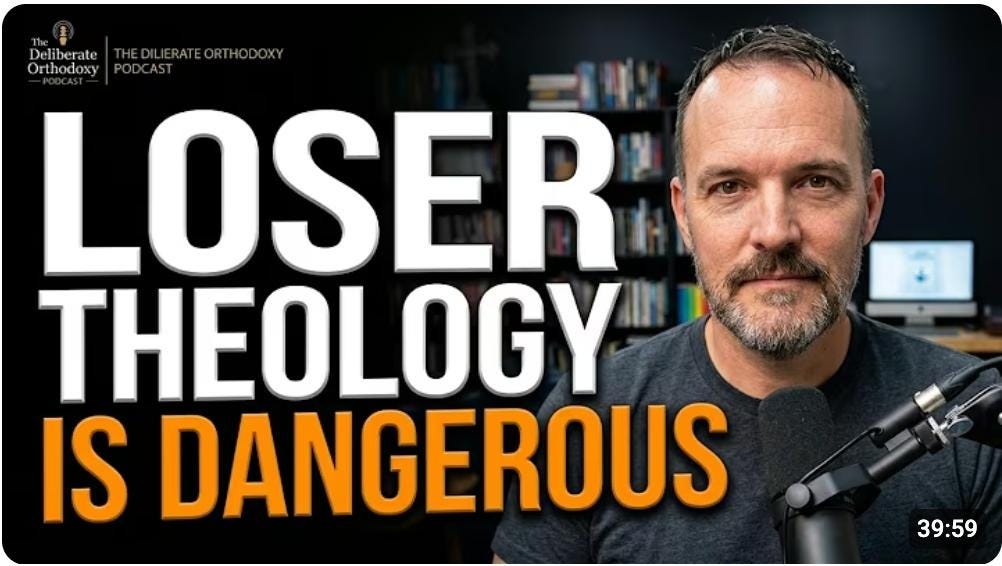
As I’ve done a bunch of media interviews, I’m getting a kick out of all the AI generated YouTube thumbnails. I mean, who’s this guy?
Nine Questions About Women’s Ministry in the Church Book
I teased this in my last update, but now I’m ready to announce it officially. My friend Zachary M. Garris and I have written a book called Nine Questions About Women’s Ministry in the Church, published by Founders Press.
So far, we have received endorsements from David Schrock, Joseph Spurgeon, and Scott Brown. It is scheduled for a January release. The see the endorsements and more, the product info page is now live.